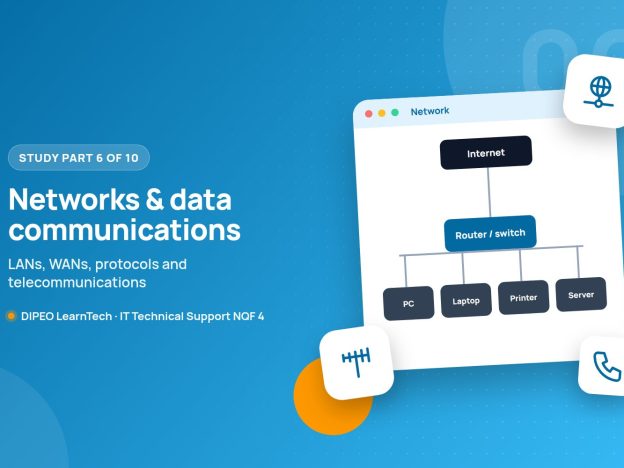
Study Part 6: Networks and Data Communications
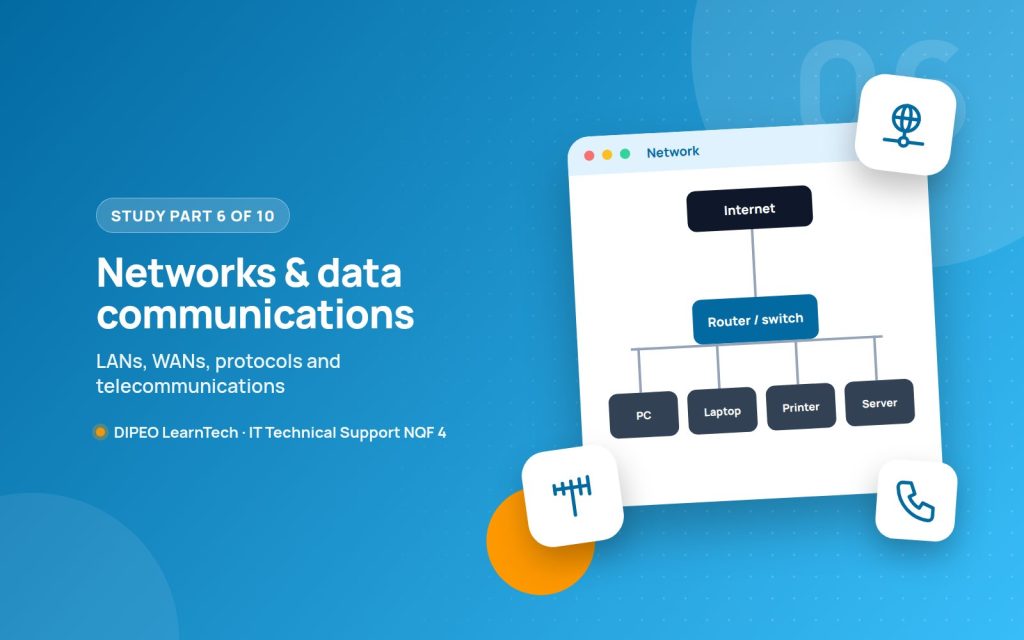
Almost every support call today involves a network. Learn how data travels from sender to receiver, the difference between synchronous and asynchronous communication, how LANs and WANs are built and how the telephone and telecommunications networks underneath them work.
By the end of this study part you will be able to
Topics in this study part
Sender, medium, receiver and the rules that make communication work.
30 min
2. Synchronous and asynchronous communicationHow sender and receiver stay in step: start bits, clocks and blocks of data.
30 min
3. Local area networksTopologies, devices, cables and Wi-Fi inside one building or campus.
35 min
4. Wide area networks and the internetConnecting branches, cities and the cloud.
30 min
5. Telecommunications conceptsTelephones, fax, analogue and digital signals, and the networks that carry voice and data.
30 min
How to pass
Work through each topic, complete the activities, then take the Study Part 6 quiz. You need 80% to unlock the next study part.
Aligned to
Unit standards 14913 (principles of computer networks, 5 credits), 14947 (data communications, 4 credits), 14932 (synchronous and asynchronous communication, 6 credits) and 14928 (basic concepts of telecommunications, 7 credits) · About 220 notional hours